d'Eglantier
  • A French 18th century
  • A French 18th century
  • A French 18th century
  • A French 18th century
  • A French 18th century
  • A French 18th century
  • A French 18th century
  • A French 18th century
  • A French 18th century
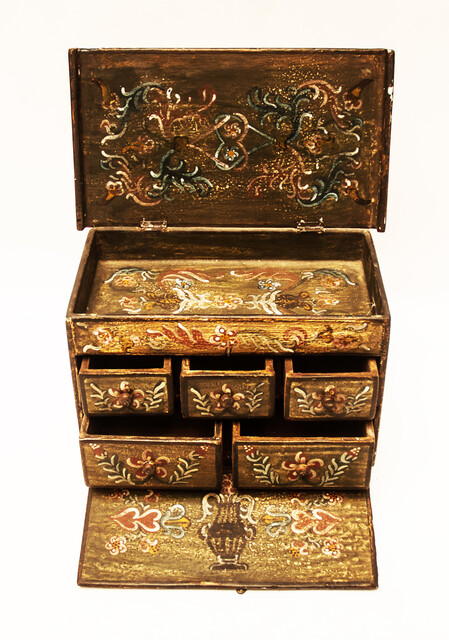
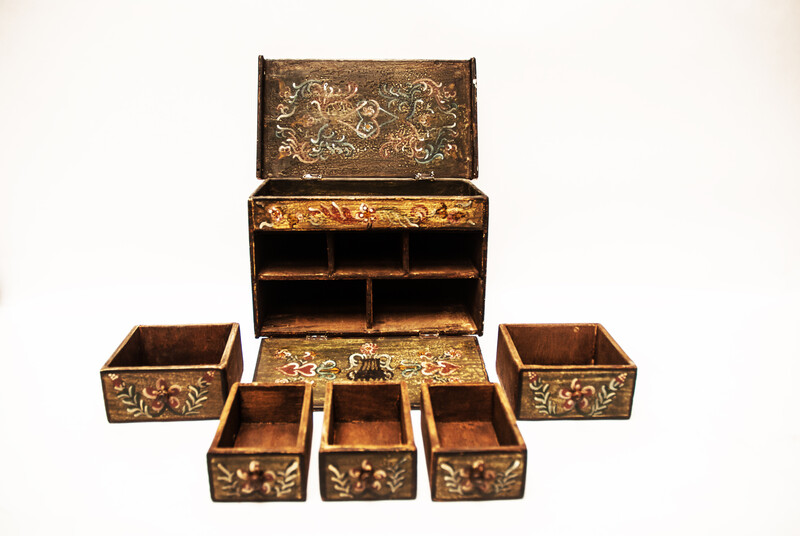
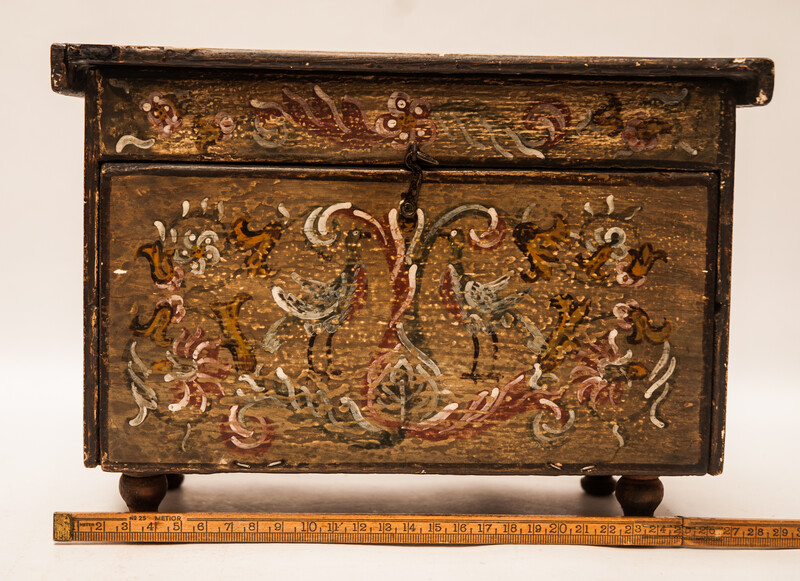
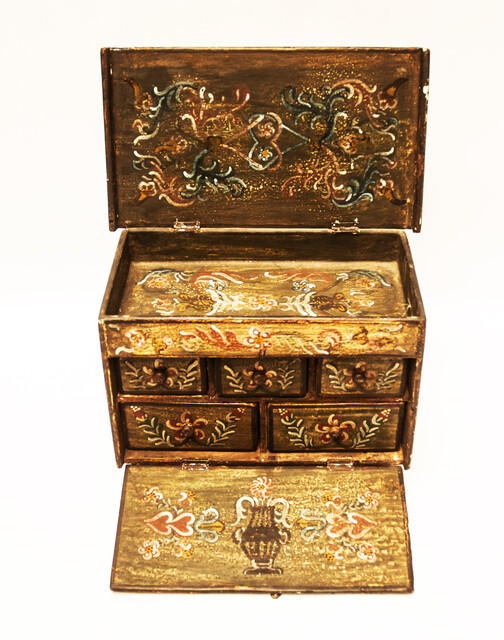
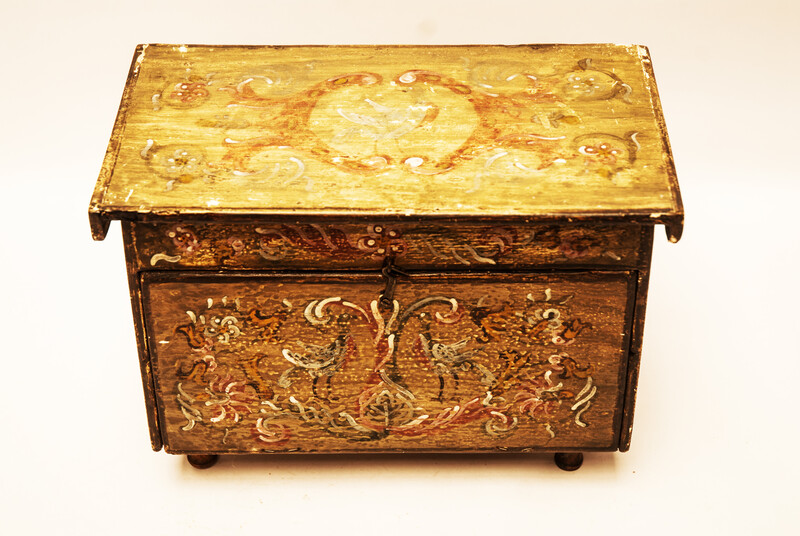
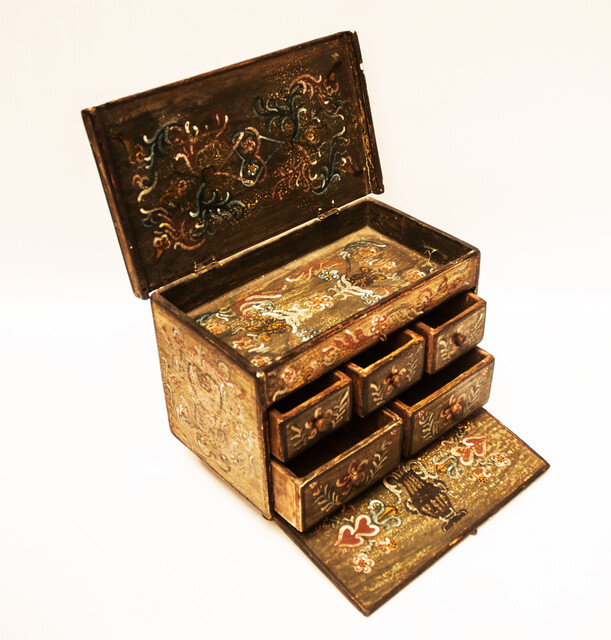
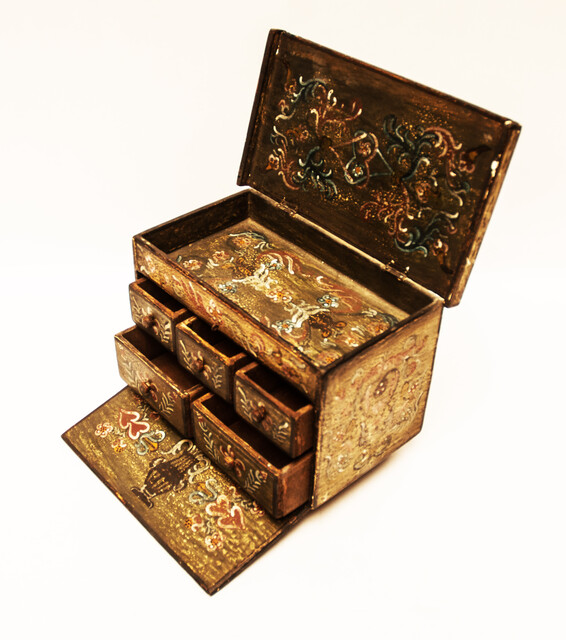
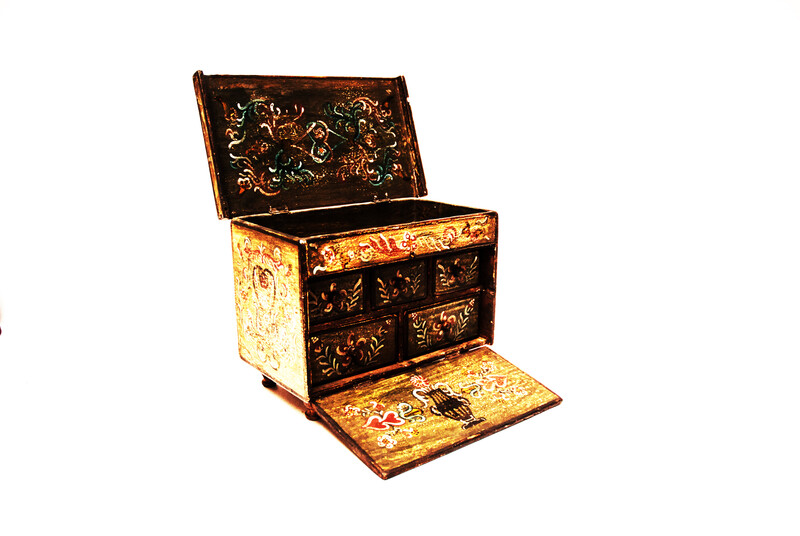
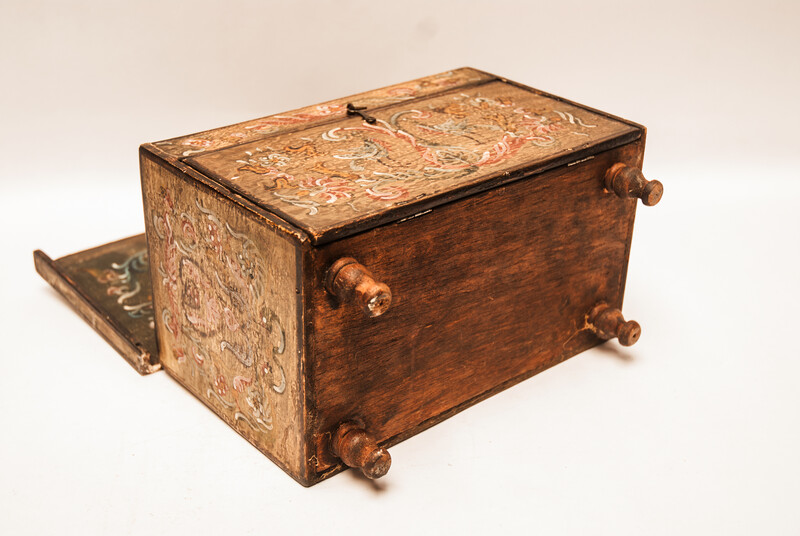
A French 18th century "Casquette d'Amour". with original painted decorations on all sides and 5 small drawers.

475 €


A painted box. High 19 cm. Wide 16 cm. Long 27 cm. Painted on inside and outside with flowers, birds and hearts. On four bun feet. With five small drawers. This type of decoration makes it likely that the origin of the box was in the South-East of France around 1700. The box and its paint are in mint condition. Similar boxes were often a wedding presents. Hence the name: "Love Box". In this condition these boxes are very rare.  

Request for more information
See more items of this dealer
Print
d'Eglantier
Address:
Egelantiersgracht 93 ,
1015 RE Amsterdam
Country: The-Netherlands
Tel.: +31 (0)20 6262061
E-mail: info@deglantier.com
Website: www.deglantier.com
A wooden painted Dutch decoy bird in the form of a coot.

A wooden painted Dutch decoy bird in the form of a coot.


A decoy. Long 28 cm. High 12 cm. Wide 14 cm. On the underside two iron bars for the application of lead weights. The decoy was apparently meant not for catching ducks but for coots. A decoy coot is very unusual. The bird is in a good general condition with signs of extensive use. Dutch, nineteenth century.
 

A French 18th century

A French 18th century "Casquette d'Amour". with original painted decorations on all sides and 5 small drawers.


A painted box. High 19 cm. Wide 16 cm. Long 27 cm. Painted on inside and outside with flowers, birds and hearts. On four bun feet. With five small drawers. This type of decoration makes it likely that the origin of the box was in the South-East of France around 1700. The box and its paint are in mint condition. Similar boxes were often a wedding presents. Hence the name: "Love Box". In this condition these boxes are very rare.
 

An eighteenth century apothecary box with text

An eighteenth century apothecary box with text "ALUIN".


An apothecary box. Long 28 cm. Wide 16 cm. High 13 cm. With a sliding lid. On the front and side the text "ALUIN". Aluin is a Potassium Alum salt and is mainly used to stop bleeding, in particular during shaving with a sharp rasor. Often found in barber shops. The box is in mint condition. Holland, around 1750.
 

Three nineteenth century Dutch Cooped containers among which one for lapwing eggs and one for soap.

Three nineteenth century Dutch Cooped containers among which one for lapwing eggs and one for soap.


Three well cooped containers. High approximately 12 cm. Largest diameter 20 cm. One of them containing eight lapwings eggs. Another marked "ZEEP" (soap). All three in excellent condition. Low Countries around 1850.
 

A Dutch 18th Century shipbuilders plane and a dated part of a panel raising plane.

A Dutch 18th Century shipbuilders plane and a dated part of a panel raising plane.


A shipbuilders plane and part of a dated panel raising plane. Length resp. 20 and 30 cm. Both 18th century Dutch. The shipbuilders plane with a hollow foot to accomodate a mast or other roundwood parts. The iron marked by a Rotterdam blacksmith. The dated plane (1779) marked "DHM". Both in mint condition.


A nineteenth century Frisian buttercup signed and dated

A nineteenth century Frisian buttercup signed and dated " S.A.Roorda 1842".


A buttercup. High 16 cm. Long 19 cm. Wide 14 cm. Coopers technique with willow branch connections. On the bottom signed and dated "S.A.Roorda 1842". Roorda is a typical Frisian name. Friesland is one of the northern provinces of Holland. Quite famous for its folk art. The cup is in pristine condition.
 

An eightteenth century Dutch firing glass with a twisted stem.

An eightteenth century Dutch firing glass with a twisted stem.


A firing glass. High 11 cm. Upper diameter 6 cm. Diameter foot 7 cm. Apparently made in two parts, with a very decorative twisted lower part. Clear unpolished pontil. In pristine condition. Low Coutries around 1750.
 

An extremely rare group of 4 three dimensional pewter people in action in the former Dutch colony Suriname.

An extremely rare group of 4 three dimensional pewter people in action in the former Dutch colony Suriname.


A group of pewter figures. Maximal height 6 cm. All figures are three dimensional and made of subsequently painted pewter. Quite exceptional is that all four people in action are coloured people. This leads in the direction of the former Dutch colony of Suriname. Gerrit Schouten (1779-1839) made several diorama's of daily tife in Suriname. The present item could be dated in the same period. The figures are all fully intact and vivid in colour.
 

A very rare Dutch paper cutting with exquisite scenes of rural life and dated 1846.

A very rare Dutch paper cutting with exquisite scenes of rural life and dated 1846.


A paper cutting. Framed. Size of frame: 46 x 40 cm.  Size of paper cutting: 39 x 31 cm. The cutting of superb quality and in its original frame. The cuttig, dated 1846 shows many scenes of rural life in great detail. On the back an old label with :"meisjes borstrokken" (girls breast covers) The cutting in mint condition.
 

A nineteenth century Dutch inn-keepers glass.

A nineteenth century Dutch inn-keepers glass.


An Inn-keepers glass. High 7,5 cm. Wide 6 cm. Diameter foot 5,5 cm. Weight 225 gram. Mint condition. This type of glass can contain only a small amount of liquid. So when the inn-keeper wants to drink on the health of his customer he will not become drunk. This type of glass is rare.
 

An 18th century Frisian wood carved and gilt rudder decoration in the form of a horse.

An 18th century Frisian wood carved and gilt rudder decoration in the form of a horse.


A rudder horse. Overall length 24 cm. Height 20 cm. Nicely carved in wood and subsequently gilt. In very good general condition with obvious signs of use. Considering the size it most likely was the decoration of the rudder of a small Frisian ship. Friesland around 1750.
 

A rare early seventeenth century Delft blue tile with a boy whipping a top.

A rare early seventeenth century Delft blue tile with a boy whipping a top.


A  Delft blue tile. Size 13 x 13 cm. Thickness 12 mm. On the tile a lively image of a boy whipping a top. Quite exceptional is the fact that the top is shown on an oval board. This makes the tile a very rare item. The thickness of this tile makes a date around the first quarter of the seventeenth century quite likely. The tile is in very good condition without damage, repair or restorations.